
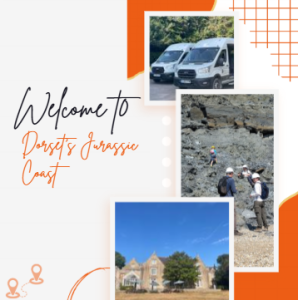
Watch the Highlights from Dorset Residential Field Trip 2026
It’s back-to-school time, which makes us want to look back and do the holidays all over again! Our annual five-day residential trip to Dorset is always a highlight of the Rockwatch calendar, and 2026 certainly didn’t disappoint!
Every residential is different, offering families the opportunity to immerse themselves in the extraordinary geology of Dorset’s Jurassic Coast. From dinosaur footprints and beautifully preserved ammonites to ancient pebbles, dramatic cliffs and geological detective work, this year’s Rockwatchers packed an incredible amount into five action-filled days.
Monday: Ready, set, explore!
Families arrived at Leeson House on Monday afternoon, ready for a week of geological adventures. After settling in and enjoying dinner together, everyone took part in a fun evening orienteering challenge led by the Leeson House team.
It was a brilliant way to explore our surroundings, meet fellow Rockwatch families and prepare for the busy days ahead.
Tuesday: Fossils and footprints around Swanage
On Tuesday, Phil led us on a journey through the rocks and landscapes around Swanage, beginning at Durlston Bay.
After carefully clambering down blocks of Purbeck Limestone, our Rockwatchers began searching among the pebbles and boulders. It wasn’t long before their discoveries revealed a fascinating mixture of marine and terrestrial life.
Finds included Scheenstia fish scales, fragments of turtle shell and fossil plants, including part of a branch from a “monkey puzzle” type tree. One of the day’s star discoveries was an excellent cast of an ornithopod dinosaur footprint.
The footprint suggested that the water must have been exceptionally shallow when the dinosaur passed through—or that the ground was briefly exposed above water. After examining the evidence and discussing the different possibilities, our young geologists concluded that these rocks were probably formed in a lagoonal environment.
Following one of the excellent Leeson House packed lunches, we continued along the coastal path, passing Peveril Point and heading into Swanage. The carnival added an unexpected splash of colour and excitement to our geological day!
Several families then continued their walk “forward in time” through the rocks. The route passed through the river-deposited Wealden Group, where large pieces of fossil wood could be seen in the cliff, followed by the Upper Greensand and finally the Lower Chalk.
There were plenty more fossils to discover, including abundant Rotularia worm tubes, Neithea bivalves, fish bones and ammonites.
Wednesday: Ammonites, sea monsters and Kimmeridge Clay
Barry led Wednesday’s adventure, which began at Renscombe Farm near Worth Matravers. A short walk across the fields brought us to a spectacular viewpoint overlooking Chapman’s Pool, the surrounding coastline and the distant Isle of Portland.
The top of the hill is formed from a thin layer of the oldest Portland Limestone, rich in chert, with the often-overlooked Portland Sand Formation below it. Beneath these rocks lie as much as 585 metres of Kimmeridge Clay, deposited over approximately 8.5 million years. Our Rockwatchers calculated that this worked out at around 14,500 years for every metre of sediment!
We then began the steep, zigzagging descent towards Chapman’s Pool. After an important safety briefing—including the useful reminder that “green is slippery and grey is grippy”—we set off along the beach.
Fossils seemed to appear at almost every step. Close to the waterfall, we examined wonderfully preserved ammonites embedded in a firmly cemented layer of Kimmeridge Clay. Many retained an impressive amount of detail.
The layer could be traced as it rose westwards through the cliff, reflecting the gentle eastward dip of the rocks seen along this stretch of coast. Part of it had also been involved in a huge rockfall during the previous winter.
Everyone enjoyed plenty of fossil-hunting time and found specimens they were happy—and able—to carry home!
Some families then returned with Eric and Mark from Leeson House, while the remaining group continued westwards into a section of coastline that can only be explored safely during spring low tides and suitable weather conditions.
After a challenging walk around several headlands, we reached the beach near the place where an enormous prehistoric marine reptile skull was discovered. It was an unforgettable setting for lunch—and even a swim!
The walk continued beneath cliffs displaying a remarkable variety of Kimmeridge Clay layers. Along the way, we encountered trace fossils, pyritised ammonites, fossil wood, coprolites, faults and fault breccias.
We finally reached Kimmeridge Bay at around 4pm, where a queue soon formed at the Purbeck ice cream hut for a very well-earned treat. We reunited with the rest of the group, who had spent an enjoyable afternoon exploring the bay and its rock pools.
This was an especially memorable excursion. The route is only accessible when spring low tides, fine weather and high atmospheric pressure combine to create the right conditions, making us very fortunate to have experienced it.
Thursday: Ancient pebbles and Portland stone
Richard led Thursday’s exploration of Portland, beginning at Chesil Beach in Chiswell.
After climbing the mighty pebble bank, we searched for some particularly unusual treasures: Budleigh Salterton pebbles. These could be among the oldest pebbles our Rockwatchers will ever hold!
The quartzite originally came from an ancient mountain range in the area we now know as Brittany. During the Late Permian Period, rivers carried the rocks northwards, gradually rounding them into pebbles. They then remained within the Budleigh Salterton Pebble Beds for around 260 million years before erosion and coastal processes carried some of them eastwards towards Portland.
Their presence at Chesil Beach provides compelling evidence of longshore drift moving material along the coast from west to east.
We also discovered that there is much more to Chesil Beach than the pebbles visible at the surface. Richard explained the remarkable engineering hidden inside it.
As sea levels rose following the last Ice Age, mud and silt formed the beach’s inner core. Flint and chert pebbles later covered it. Because water can pass through the pebbles but not the impermeable core, engineers constructed an interceptor drain along the boundary between them. Large openings on the seaward side allow stormwater to drain away.
Installed following two catastrophic storms in 1979 and 1980, the system has helped protect Chiswell from serious flooding ever since. It was a fascinating glimpse of geotechnical engineering—and perhaps inspiration for a future career!
Our day also included a visit to Portland Museum during its archaeology open day, followed by King Barrow Quarry, where we explored the history of Portland stone and learned how it was quarried in the past.
The variety of the week was one of its greatest strengths. Across the different excursions, families explored geology, palaeontology and geotechnical engineering, with activities carefully adapted to the weather, conditions and different ages and abilities within the group.
As one family told us:
“We especially enjoyed the variety in the expert-led day trips. It was a great balance between geology, palaeontology and geoengineering.”
The more and less strenuous options offered on the Kimmeridge day were particularly appreciated, while the visit to Portland Museum provided a fascinating—and cooler—activity for younger Rockwatchers during the hot weather.
Friday: A final walk to Dancing Ledge
On Friday morning, we walked from Leeson House to Dancing Ledge for one final encounter with Dorset’s remarkable geology.
This broad, level shelf is formed from Jurassic limestone and was enlarged by historic quarrying for Portland stone. The cliffs reveal layers of Portland Freestone and the chert-rich rocks beneath it, while fallen blocks from the younger Purbeck Formation contain fascinating structures created by ancient microbial communities.
The rocks also preserve evidence of the area’s marine past, including ammonites, bivalves, sponge spicules and burrows made by crustaceans. Small caves and mineral deposits provide clues to the geological processes that are continuing to shape the coast today.
A tidal swimming pool cut into the rock is another reminder of how people have adapted this dramatic landscape. When the tide washes over the low, flat shelf, the moving water appears to shimmer and “dance”—a wonderfully fitting final sight before we returned to Leeson House for lunch and began our journeys home.
Thank you for an unforgettable week
A huge Rockwatch thank you goes to our leaders Phil, Barry and Richard for sharing their knowledge, experience and enthusiasm throughout the week. Whether they were identifying fossils, explaining changing environments or patiently answering an endless stream of questions, their expertise brought Dorset’s geology vividly to life.
We would also like to thank the whole Leeson House team, including Clare, Kate, Eric, Emma and everyone who helped to make the residential so special. From the warm welcome and comfortable accommodation to the delicious meals, packed lunches, activities and transport, they looked after us brilliantly.
Most of all, thank you to all the Rockwatch families who joined us. The friendships, laughter, lively conversations and shared curiosity are every bit as important as the fossils we find.
One family summed up the experience beautifully:
“The trip was a real highlight of our year and such an inspiring opportunity for the children.”
Another young Rockwatcher returned home inspired to begin creating an entry for the Rockwatch Rockstars Competition. For one family, even the fossils and hard hat they took home have become reminders of the happy memories made during their week in Dorset.
Watch some photo highlights from the trip on YouTube!
Watch the Highlights
