
On 4th July, Kevin Taylor from the University of Manchester and Mick Oates from Rockwatch joined members for a fun-filled day exploring Staithes Yorkshire Coast. Here Kevin explains what our young geology explorers discovered.
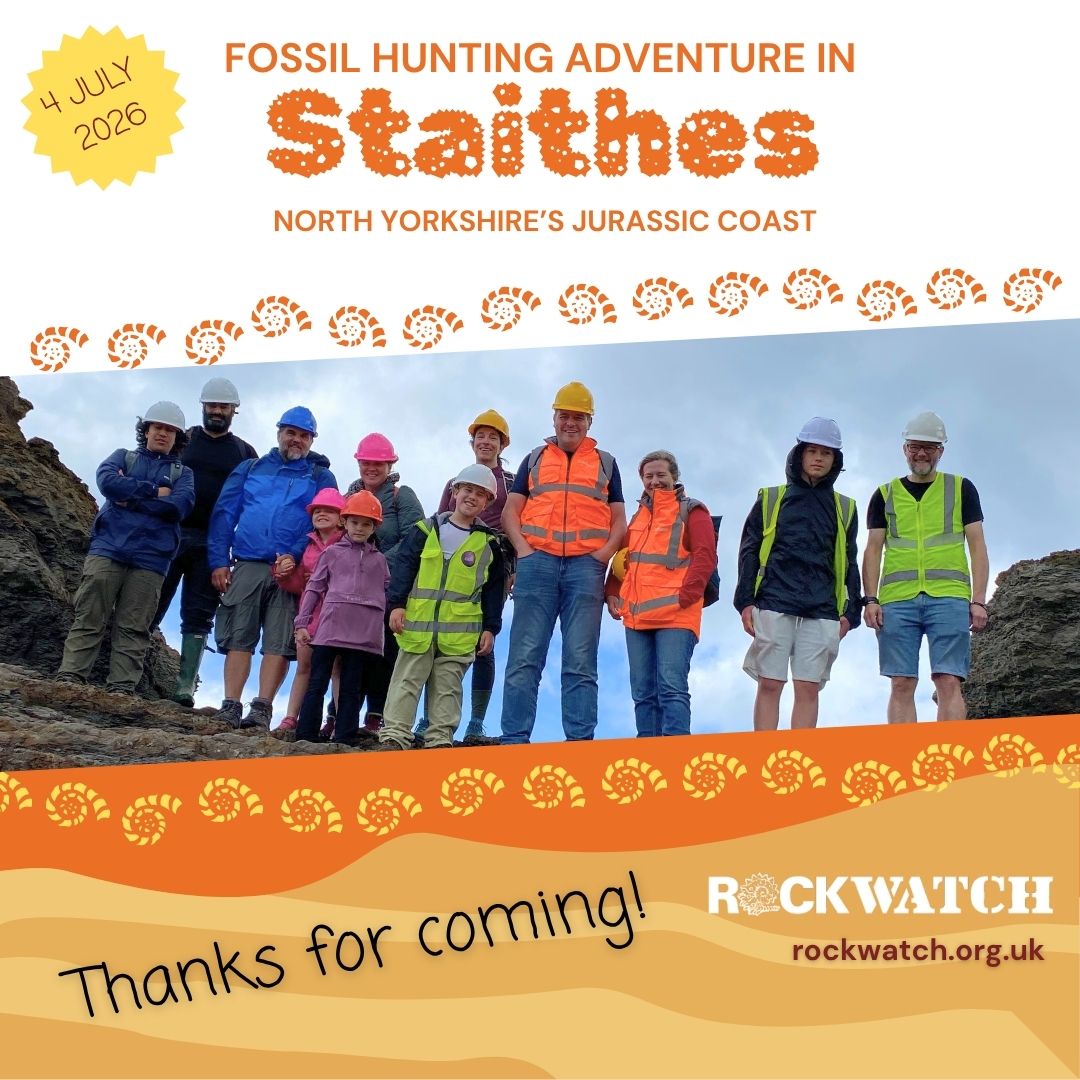
The aim of this day trip was to spend an enjoyable and educational day examining the fossiliferous foreshore at Staithes, with particular emphasis on finding fossils and considering what they reveal about the environment at the time of deposition. Staithes is well known for Lower Jurassic rocks exposed along the foreshore, where ammonites, belemnites, bivalves and trace fossils may be found in loose blocks and fallen material.
The weather was fine, which contributed to a successful and enjoyable day on the coast. The fossils found during the day were mainly recovered from fallen blocks on the foreshore. This provided a safe and productive way to observe and collect fossils while also considering the geological setting of the site. They included ammonites, belemnites and several types of bivalves, including pectens and oysters. Trace fossils were also observed, with the best examples being excellently preserved Rhizocorallium. These specimens provided a useful opportunity to discuss both body fossils and evidence of animal behaviour preserved in the sediment.
The fossil assemblage indicates deposition in a shallow marine environment. The presence of ammonites and belemnites shows that open marine organisms were present, while the bivalves and trace fossils suggest activity on or within the sea floor. The well-preserved trace fossils, especially Rhizocorallium, point to an oxygenated substrate that supported burrowing organisms. Overall, the fossils are consistent with a shallow, well-oxygenated Jurassic sea.
In addition to the palaeontological observations, the group noted evidence of former ironstone mining in the area. Pit props and related mining remains were observed, providing an important reminder of the historical significance of the Cleveland Ironstone Formation and its exploitation along this part of the Yorkshire Coast.
Thank you to Kevin and Mick for leading such an enjoyable and fascinating day, and to all the young geologists and families who joined us!
